PAN Amsterdam 2026: ORPHEUS, A DOMESTIC LANDSCAPE BY THE MILLEN HOUSE

 Booth 97
01.11-2026 - 08.11.2026
https://www.pan.nl/en
Booth 97
01.11-2026 - 08.11.2026
https://www.pan.nl/en
ORPHEUS, A Domestic Landscape by The Millen House
Da stieg ein Baum. O reine Übersteigung!
— Rainer Maria Rilke, Die Sonette an Orpheus, 1922
For PAN Amsterdam 2026, The Millen House presents ORPHEUS, a domestic landscape loosely inspired by Rainer Maria Rilke’s Sonnets to Orpheus and the ancient myth of the poet who crossed between the living world and the underworld.
A sideboard, lounge chairs, books, vessels and a lamp form the familiar architecture of a home. Yet throughout the room, ordinary things carry echoes of somewhere else. An iron grows nails. A vessel grows snakes. Timber bears the memory of fire. Wood holds the shape of a remembered embrace. Carbon fibre hangs almost weightless in the air.
Works by twentieth-century masters and contemporary artists move between image, material and memory, allowing older stories to surface without illustrating them. Orpheus descends; Icarus rises towards the sun. Between these opposing movements lie fire and air, weight and suspension, destruction and renewal, the natural and the constructed.
Myth remains deliberately fragmentary. There is no Orpheus, only descent, absence and return. No Icarus, only flight, fire and the possibility of falling. Like memory, these stories emerge through recognition and association.
ORPHEUS is not an illustration of mythology, but a house in which the familiar seems to remember something older.
-
 Carel Visser, Boom, 1993
 -
Joe Sterck, Phoenix cabinet, 2026
-
Gio Ponti, Devil Mask, 1956
-
Natasja Alers, Blue Snake Vase, 2026


-
Marleen Kaptein, Parallax VII – Chandelier, 2026
-
Diana Bitar, L’homme propose et Dieu dispose, 2025
-
Marleen Kaptein, Parallax VIII – Chandelier , 2026
-
Bernard Aubertin, Tableau brûlé, 1978


-
Bernard Aubertin, Monocromo Rosso, 1961
-
Kwok Hoi Chan, SZ15, 1973
-
Christiaan Paul Damsté, metal sculpture, ca. 1970
-
Dries Engelen, Totem, ca. 1965




ORPHEUS, A Domestic Landscape by The Millen House
Da stieg ein Baum. O reine Übersteigung!
A tree rose. O pure transcending!
— Rainer Maria Rilke, Die Sonette an Orpheus, 1922
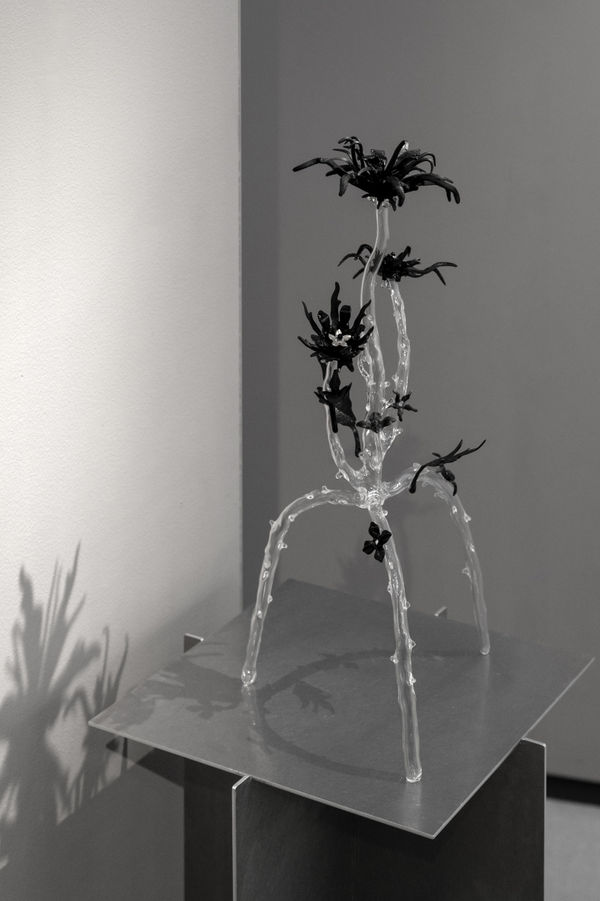
A tree rises. A flame disappears but leaves its shadow behind. A vessel grows snakes instead of handles. An iron, stripped of its purpose, sprouts a row of nails down its spine and becomes a weapon disguised as a gift.
This is ORPHEUS: not an illustration of the myth, but the house it might have left behind.
Rilke's Sonnets to Orpheus move through a world where boundaries are porous. Animals listen, fruit ripens, breath dissolves into air; objects, nature and the dead inhabit the same poetic landscape. Transformation is everywhere, but so too are memory, disappearance and return. The Millen House borrows this permeability and gives it four walls. A sideboard, lounge chairs, a low table, books and a lamp form the furniture of an ordinary evening, except that everything in the room seems to carry the memory of somewhere else.
Man Ray's Le Cadeau (1921/1974) sits on the table as the presentation's quiet thesis: the most domestic object imaginable — an iron — rendered permanently, beautifully useless, its nails facing out. Gio Ponti's enamelled Devil Mask (1956) hangs nearby, grinning. Natasja Alers' Blue Snake Vase (2026) grows snakes where its handles should be, while Joe Sterck's Phoenix cabinet (2026), made from reclaimed wood and bleached paper, becomes both sideboard and apparition: a piece of furniture named for the creature that can only be reborn through its own destruction.
Close by, Bernard Aubertin's burned timber has already encountered the flame. Fire is no longer present, but its action remains embedded in the surface — destruction turned into image, an event preserved through its aftermath.
Carel Visser occupies another register: memory pressed into material rather than material subjected to fire.Tweelingzusters (1991) began as a recollection of his wife and her twin sister embracing, distilled into two wooden forms whose grain, fractures and weight remain insistently present. Boom (1993) holds the image of a tree somewhere between recognition and abstraction. Hoogvlieger (1991), meanwhile, introduces an upward movement — a fragile construction caught between image, gravity and flight.
A different relationship between image and material appears in Karl Rödel's Female Head. Cut into a fractured slab of slate, the figure seems less imposed upon the stone than discovered within it: a handful of incised lines allow face, hair and profile to emerge from the material's existing contours. A second slate carving, a fish, appears near the threshold. It is a small detail, but one that opens another association: to reach the underworld, Orpheus first had to cross a river.
Above this heavier material world, Marleen Kaptein's Parallax works introduce another condition. Carbon fibre and LED are suspended rather than grounded; industrial material becomes line, light and apparent weightlessness.
The room consequently pulls in two directions at once.
Orpheus descends for Eurydice. Icarus travels upward towards the sun and falls.
ORPHEUS stages neither story. Instead, descent and ascent remain latent within the objects: weight against suspension, darkness against illumination, burned surfaces against air, things drawn towards the earth beside others that appear to resist it.
Myth operates here much as memory does. It arrives in fragments. There is no Orpheus, only descent, loss and the trace left by a hand in wood or stone. There is no Icarus, only flight, fire and the possibility of falling. A snake, a devil, a phoenix or a fish can awaken stories far older than the objects that carry them without ever becoming their illustration.
The domestic setting holds these contradictions without resolving them: raw wood against LED light, bronze and clay against carbon fibre, a devil beside a phoenix, ascent beside descent, function undone into image.
Nothing here abandons the ordinary world entirely.
The iron remains an iron.
The vessel remains a vessel.
The cabinet remains furniture.
Wood remains wood.
And yet, for a moment, each seems capable of remembering something else.


